Sunday, April 11, 2010
Welcome to Paradise
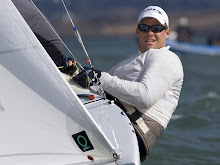
The conditions were nearly perfect with 15-18 knots out of the east. After a leisurely lunch with Sr. Durwood Knowles we ventured out for an afternoon sail. The boat was chartered and new to both of us and the discussion to fine tune the setup was very educational.
We sailed up wind for an hour trying a few different settings and discussing a rang of subjects. Thoroughly enjoyable but not nearly as fun as the ride back down hill in big waves along side a 100+ foot yacht that slowed down to watch us surf home.
Andrew arrives tomorrow and racing starts Tuesday with the Knowles Series warm up regatta followed by four days of racing for the main event. Rumors are for big breeze and big waves. We expect fun racing here in paradise!
Thursday, March 4, 2010
Always have an Exit Strategy
This winter one important area of improvement has been how we exit the weather mark. The major mistake most teams make is they are far too focused on the boats around them and getting the kite set, and not aware of where they are going down the next leg. The problematic strategy of getting the boat set up, then figuring out where we are going, can handcuff you for the whole run if you are not careful.Like many things in sailing, having a good weather mark rounding is all about preparation. You need to know what the plan is before you round so the tactician can make one simple, all important call: set high, or set low. If the call is set high, the crew needs to be patient making sure that the boats behind have turned down before the set so the team can hold a lane on starboard. If the call is set low, the crew needs to get the kite up right away and be ready for a jibe if needed.
How do you know what the right call is in the chaos that normally accompanies a weather mark rounding? Good preparation. On the last tack into the weather mark the crew should look down wind for the weather mark, generally you should be able to see if it is right or left of head to wind. The skipper should let the crew know if the wind is in right or left phase. These two facts will tell you what the long jibe is.
Second, while on the layline or offset the crew should look for the wind. Is there more pressure on the right or left? Are there any puffs in the next 30 seconds that will help exit the mark? As you pass the weather mark, check for current.
Finally, know your competition. Are the boats around you bunched up or is there a good gap to set? Will the boats around you fight high? Are you overlapped? Putting these simple facts together should tell you how you want to exit the mark, and with a good exit strategy, you will have the jump on your competition.
Some examples:
Star South American Championships – Rio de Janeiro, Brazil
Back in November at the South American Championships, Andrew Campbell and I rounded the first mark in the top three with a good gap behind us. We set low, sailing a heading half way between the boats ahead of us and VMG. Torben Grael set high behind us, knowing that the current made the downwind leg starboard jibe dominant. We had plenty of clear air at first, but as the boats above us got into the more favorable current we lost our lane, got frustrated, jibed out, and finished 14th.
Etchels Jag Series 1 – Miami, FL
Having learned the lesson, the next opportunity to put it to practice was in the 45 boat Etchels fleet in Miami in December. Being one of the most competitive and evenly matched fleets, everyone gets to the weather mark at the same time. This creates the problem of a high traffic fight for clear lanes, as well as a terrible “cone of death” under the weather mark. Our team had shared the lesson from Rio and we were very patient on the set, reaching high over a large pack of boats and were able to sail away in clear air passing more than a dozen boats in the first part of the run.
Star World Championships – Rio de Janeiro, Brazil
Back in Rio, Andrew and I were not going to make the same mistakes twice and with the help of coach Ed Adams, knew the current, and wind situations and had a plan for the run long before we got to the weather mark. It was essential to hold on starboard so I, as the crew, looked aft around the offset and did not set the pole until the boat behind us bore away and set. We gave up a little distance, but never got rolled. The patience prevailed and we were always able to pass the boats that were forced to jibe out early.
Etchels FL Stat Championships – Miami, FL
This past weekend the mark roundings were famously congested with some major collisions. Your rounding essentially dictated your entire run as there were very few clear lanes to be found. In the shifty conditions out of the NW on day two, Team Widespread Panic had four very good sets, two high and two low that were the difference between a top 15 finish and a top 30 finish. As the tactician, I was able to find the mark on the last tack, look for wind on the offset and make a clear call to our skipper. Our improvements at the weather mark resulted in Dr. Steve's best finish ever at a Jag Cup Regatta.
Next up is the Bacardi Cup which begins Monday in Miami. Andrew will finish up with Ninkasi on Sunday and jump right into the Star. We are looking forward to a great week!
Saturday, January 16, 2010
Off to the Races
(Photo by Fried Elliott - http://www.friedbits.com/)The 2010 Star World Championships kicked off today with Race 1 inside the bay in Rio de Janeiro. It only took two attempts to get a clean start right next to the Rio airport with an ebb tide pushing the boats towards the line. With the committee boat end favored in the current, Andrew and I played it safe, starting one third of the way down the line looking for less confusion and some clear air. We found neither, but Andrew did a masterful job of managing traffic and working our way to the right to get out of the current.
To say that the tidal flow inside the bay was confusing would be a drastic understatement. It was easy to be in one knot less current only one hundred feet away from a competitor. As we approached the mark along the starboard tack layline, we thought we were fetching the mark easily until we saw the lead boat stop in their tracks. Only 50 feet from the mark there was a tide line with a two know differential. Needless to say we did not lay the mark, and on our second attempt to round, we were swept into the mark. (The leaders, and countless others made the same mistake.) This double oops cost us 20 places according to a friendly spectator.
Both runs were a game of when to jibe and cross the current line. On the first run we guessed correctly and passed boats, on the second we waited too long and dropped four boats. The second and third beats were all about finding the current eddy that would give you an upwind advantage. World Champions, and locals Torben Grael and Alan Adler both showed the fleet where everyone should have been, passing boats on either side of them.
Tuesday, January 12, 2010
Star Worlds 2010 - Rio de Janeiro
Andrew and I have been in Rio this week training for the 2010 Star World Championships, which begins Saturday January 16th with 81 teams, representing 20 Countries. So far the training has been excellent despite the oppressive heat, with local fleet racing this past weekend, and Team USA coach Ed Adams running drills and practice races this week.
We expect this World Championship to be very strong with our competition including: 2009 World Champions George Szabo/Rick Peters (USA), 2008 Olympic Gold Medalists Iain Percy/Andrew Simpson (GBR), ISAF top ranked star team Flávio Marazzi/Enrico de Maria (SWI), and past world champion skippers Xavier Rohart (FRA), Fredrik Loof (SWE), Alan Adler (BRA), Robert Scheidt (BRA), and Ross MacDonald (CAN). Not to mention 5 time Olympic medalist and world champion sailor, Torben Grael who was named Rolex International Sailor of the Year in 2009 after winning the Volvo Ocean Race.
We are not daunted by the level of competition, only driven to show our best stuff and start 2010 off with a bang! Stay tuned this week for more from HOT sunny Rio de Janeiro.
Monday, November 23, 2009
Has Parity Returned to Star Equipment?
Today was a beautiful day of training on Rio off of Copacabana Beach. We had six boats out for speed testing, amongst them, three world champions, four different boat builders, four sail makers, and in the first lineup over 20 minutes, nobody had a major speed edge. There has been concern over the past few years that the star class has become out of reach for all but the top professionals, but in reality the top professionals gravitate towards the star class because they can showcase their talents against the best.At dinner the discussion turned to the boat market. In the US alone there are at least six Olympic boats, from three builders, for sale for between $30,000-40,000. In terms of sails, Quantum has been using the same Z4/P2 for the last few Olympics, Ian Percy’s Gold Medal combination is available from North, and there are at least three new sail makers in the mix. There are now boats and masts being built in the US, so now is the time to get in to the best racing around.
Andrew and I are training in Rio for the South American Championships which begin Thursday. Stay tuned for more this week!
Sunday, September 20, 2009
Lessons learned from Weymouth
We capped off our summer Star season with the Sail for Gold Regatta on the 2012 Olympic Venue in Weymouth England. While we had high hopes going into the event with an entire season of top 6 finishes and a chance to win the World Cup overall title, yet the result was less than stellar.So what are the major lessons from our first trip to Weymouth:
1. Settings from one tack to another often needed to be very different, due to confused sea state and proximity to the shoreline. Sometimes port would be straight into 1 meter swell, while starboard was extremely smooth with waves loading and unloading the boat to the point that the crews were in the water very often if the boat wasn’t properly powered at all times.
2. Geography has a major impact on the game. The valleys and cliffs surrounding the sailing area make enormous impact on the shifts and Portland Bill makes a huge impact on the current (it causes a 6 knot run of current at the end of the point during max ebb and max flood, thankfully we don’t have to race out there).
3. Racing inside the breakwater can be scary for the Star boats in heavy air! Not having waves makes it incredible difficult to unload the main for gybes.
4. Everybody has bad races. Recovery wins regattas and the easiest points to pick up in an event are from 50th to 20th. Chipping away when you’re up front as well as when you’re behind is the only way to win long series. When things aren’t going your way, just keep putting in your best effort up until they do.
5. You cannot compete against the best in the world without committing 110%. Andrew and I had a great season with borrowed equipment, little practice, and a shoestring budget. Going forward it is going to take a lot more to win a medal and this regatta was a good wake up call.
So, we finished 16th this week, 7th in the World Cup standings, but are steadily climbing up the World Rankings (27th before the new rankings come out) so this season has turned out to be an incredible learning experience as a new team.
It won’t stop here though. We will ship a boat out of Miami in two weeks to be ready for the South American Championships in November and lead-up to the 2010 Star Worlds in Rio in January.
Tuesday, September 15, 2009
A Windy Test
Survival was the name of the game for many sailors today as the wind broke the 30 knot barrier in Weymouth. With conditions at the edge of sailable for many boats, the race committee kept the fleets to two courses, each manned with plenty of safety boats.The Stars were the last to start on the Harbor Course as the dark clouds began to push in from the east and the wind topped out at 38 knots on the lighthouse at the harbor entrance. Andrew and I decided to start safe to leeward of the pack bunched up at the heavily favored boat end of the line. We made it to the weather mark in the top ten, but the boats were so tightly bunched that we had our air stolen and had to bail out, finally rounding in… LAST!
Down wind it was full on and we jibed away from the fleet into clear water as Stars make a huge stern wake in these conditions. By the leeward mark we had clawed back to mid fleet and a good leeward mark rounding put us back in the top ten.
On the second run it was survival conditions, no pole running. Half way down the run a massive puff came down the course causing chaos and taking one rig out. We adjusted our course and caught the puff perfectly, planning down the run, rig pointed skyward.
On the last beat we were able to hold position and then fend off a tight pack of 6 boats close on our stern to finish 7th. An improvement on yesterday but it showed how much work we still have to do in these conditions.
Tomorrow the weather looks to be more like traditional Weymouth; cold, windy, with rain. At least two races scheduled tomorrow with 7 more by the medal race on Saturday.
Sunday, September 13, 2009
Welcome to Weymouth
Andrew and I have made our way to Weymouth England for the seventh and final event of the ISAF World Cup season. Weymouth is the site of the 2012 Olympic sailing events and the venue is well on its way to completion. The British National Sailing Center is complete and the athlete village has topped out construction, three years in advance of the games.The Star Class is stacked this week with the top six finishers from the Beijing, and 13 of the top 20 in the ISAF World Rankings; all here to vie for the overall title and study up on the Olympic venue. This amount of talent would be spectacular in any large fleet, but there are only 20 Star boats registered. This will be a very hotly contested regatta.
We race two races a day Monday through Friday with the medal race on Saturday. Follow along at http://www.sailracer.co.uk/events/18401/ and see our daily updates at http://www.campbellnichol2012.blogspot.com/
Monday, August 17, 2009
Coming Home
This week was “Star Week” at the Lake Sunapee Yacht Club in New Hampshire, kicking off with the Jr. Western Hemisphere Championships, followed by the Sunapee Open, and culminating with the 12th District Championships. I was happy to find the time to make it home for the Open and take the helm against friends who had traveled from Annapolis, Michigan, Toronto, and other points north. Growing up on Lake Sunapee was a special experience where I was exposed to an enthusiastic group of sailors who happened to comprise the largest inland fleet of Olympic Class Star boats in the world during the 1980’s. Lake Sunapee is surrounded by mountains - known for its fickle winds, and is certainly a difficult place to sail. Growing up I use to find the highest vantage point possible and watch the puffs fill across the lake, bend around points, and die out under the hills.
The light shifty winds on Sunapee taught me patience, perseverance, and above all, no matter what happens, you always have a shot a coming back. This was demonstrated on Saturday in the second race when my crew John Corrigan and I had a beautiful start, two boats down from the pin, and lead the fleet towards the weather mark. A few boats tacked out behind us as we continued straight towards the mark and fell into a gaping hole (area with no wind). John calmly gave me the play by play as the rest of the fleet sailed around us on both sides. We did everything we could to keep the boat moving and made it to the weather mark in 14th. Seemingly out of contention with the leaders minutes ahead, we methodically plotted our course downwind connecting the dots with puffs barely visible on the water.
By the time we reached the leeward mark we were just boat lengths behind the lead boat in a cluster of five trying to sneak around the bottom mark. The wind held steady for the second lap and we were able to hold a 6th place finish for the race, our second of the day. The 6, 6 score line put us in 5th for the day only 2 points out of 3rd.
Sunday brought a second day of beautifully sunny skies, but unfortunately, no wind. The competitors stayed on shore and enjoyed the mountain views form the club and floating in the lake as no wind ever materialized. All in all, it was a wonderful weekend, as much about seeing friends and enjoying a beautiful place as it was about the racing.Next up Andrew Campbell and I head to Weymouth England, host of the 2012 Olympic sailing events, for the final leg of the ISAF Sailing World Cup. Andrew and I are 3 points out of the overall lead after six events and hope to move up with another solid result.
Thank you to all the LSYC members who put on a great regatta each year and helped me get my boat to the lake, and ready to race. Also to MacDesigns Inc. for providing the beautiful decals for the regatta.
Tuesday, August 4, 2009
Youth and Enthusiasm in the Star Class
Varberg, Sweden - There are plenty of young teams at the Star World Championships who are in their mid-late 20's and early 30's who can never be ruled out of being in contention for a top 10 finish. Peter O'Leary and Tim Goodbody (IRL) are now 26, John Gimson and Ed Greig (GBR) and most of the strong German teams fall into the same category. Even 25-year-old Andrew Campbell, the USA's 2008 Olympic Laser representative has qualified for USSTAG in the Star. He is sailing with the legendary Star crew and Olympic Gold medalist and World Champion in the Star, 55-year-old Magnus Liljedahl. Of course, there is always a place for strong, physically fit and enthusiastic crew. Portuguese Star sailor, Afonso Domingos is sailing with 21-year-old Frederico Melo, who raced in the Finn Gold Cup in Denmark. Campbell is currently the youngest skipper and Melo is currently the youngest crew in the top 10 at the 2009 Star World Championship.
Whether they are confident of their Star sailing abilities or not, juniors can join the class. First time experiences are often as crew, but some hop in and take the helm. One of the next events on the Star Class calendar that includes over 220 organized regattas annually is the Western Hemisphere Youth Championship in Lake Sunapee, New Hampshire on August 14th. It is open to any skipper who has not reached his or her 25th birthday prior to the first race, and there is no - no limit the age of the crew. Past events have been great opportunities for the likes of Brad Nichol, current member of US Team Alpha Graphics to learn from accomplished New England sailors. At this stage in his life, the regatta represents an opportunity for those with accomplished Star careers to give back to the class and to scout for talent. The Lake Sunapee Open follows the Western Hemisphere Youth Championship on August 15 - 16 and Star sailors of all ages are welcome to attend.
Wednesday, June 24, 2009
Kieler Woche - Wrap-Up
Andrew and I could conceivably move from our 9th position at the beginning of the day to as high as 5th if everything went perfectly but we had to depend on too many scenarios to play out so our goal was to break out and win the race. We won the start about two thirds of the way down toward the pin. When the fleet on our hip eventually tacked we consolidated and lifted off the group in a nice lefty while pinching off the boats still to the left of us. Mark Mendelblatt and Mark Strube, the other American team in the medal race, crossed behind us to the left and in the last 300 yards of the leg were able to snag a nice lift into the top. We rounded close behind in second. In an attempt to pass those guys, we gybed away and split from the group, but that turned out to be a loss of about three boats and we spent the rest of the race clawing back to a 3rd in the race. We were happy to find out that the 3rd sent us two spots up the scoreboard to take 7th in the regatta.
What a funny series we’ve had here: Only three days of racing two of which were one-race-days. Andrew and I are happy with the finish after so many teens to start the regatta. We have one more World Cup event on the schedule: Sail for Gold in September in Weymouth. We are currently fifth overall in the standings, but only three points out of the lead. It will all come down to a good finish in the World Cup Finals!
You can find daily video highlights at http://www.world-of-sailing.info/olympic-classes/star/ including areal coverage of the medal race. There should be GPS tracks of our medal race online at the Kieler Woche website but we have not been able to find the link yet.
As always, thank you to our sponsors – USSTAG, Sperry, Kaenon, North Sails, McLube, and all of our supporters who sent good wishes all week.
Tuesday, June 23, 2009
Kiel Week - Medal Race Bound
Tomorrow we have the medal race which counts double and then back home for July 4th weekend.
Andrew and I were both interviewed by SailTV this evening. We will let you know when it is available online.
Sunday, June 21, 2009
Kiel Week - Race Days
The race we did get off was challenging, with a pin biased start and a left shift early in the first leg. Andrew and I were flushed at the start and were able to catch a good shift on the right and consolidate to the middle of the fleet. The rest of the race we picked away at the fleet and finished 12th. A keeper in a tough fleet.
We have three races scheduled Mon and Tues with the Medal race on Wed. Hopefully the weather will cooperate.
Look closely at our boat in the picture, we are hiding under the main to avoid the hail!
Friday, June 19, 2009
Kieler Woche - Training
Kiel Week is a bit different from the other World Cup events in that it is part of a big festival. Think about having a Sperry NOOD Regatta and then adding a carnival in shore with food booths, beer gardens (we are in Germany) and small rides for the kids. The do a great job getting the public involved.
Racing stars tomorrow with two races a day through Tuesday and a medal race on Wednesday. Stay tuned tomorrow for more news and a picture from coach Mark Ivey on how to survive a hail storm on a star boat.
Monday, June 1, 2009
Delta Lloyd Regatta 2009 Wrap-up
What a week it turned out to be in Holland! The sun was out and the breeze was on for the last four days of the regatta, a phenomenon that does not often happen in northern Europe. We were treated to some great racing from the Dutch organizers and race committees who are legendary for running on-time races and never letting a boat over early slip past them.Wednesday, May 27, 2009
Delta Lloyd - Day 1, Breeze On!
Each sailor that came off the water today had a different word to describe the conditions. Serious, extreme, full-on, crazy, wild. For us it was about survival. When you get a Star boat going down wind in 25-30 knots (some claim 35) it is all you can do to hang on, keep the boat pointed in the right direction, and most importantly, the mast pointed skyward. We did all those things and notched a single digit finish so there is nothing to complain about.At the finish of the first race we got ourselves back under control and made some minor adjustments before looking around at the fleet. It was carnage. Of the 29 competitors, 5 had breakdowns and did not finish the race, and one World Champion broke his mast right after finishing. The wind was gusting over 30 and the waves had stacked up to four feet in the shallow fresh water making them very close together. Full-on.
At that point the race committee decided to end the carnage and send us home. It was a long cold 3-mile slog back to the harbor and a hot shower and big Italian dinner with the US Sailing Team capped off a long day. Racing continues through Sunday. Stay tuned…
Sunday, May 24, 2009
Delta Lloyd Regatta - Arrival
Here in Medemblik they sail some very traditional boats in very shallow water. To keep from constantly running aground, the boats were designed without a keel and with very shallow drafts (flat bottom). To keep the boats from sliding sideways, a leeboard was added. For those of you who did not grow up sailing sabots in southern California, a leeboard is like a centerboard on the side of the boat.
Now when you bring a big boat into port, you do not want to break off your leeboard on the dock, so you always tie the boat on one side – the PORT SIDE. When sailing, boats tend to heel over putting one side lower into the water. When on PORT TACK the leeboard is lower in the water, making the boat more maneuverable and on the other stack the leeboard is up in the air making boat handling difficult. Therefore, a boat on PORT TACK shall always keep clear of a boat on starBOARD TACK because she has more maneuverability.
I am sorry to say it took me more than 20 years of lessons and coaching to learn that!
I am in Medemblik sailing The Delta Lloyd Regatta which starts on Wednesday. So far things have been going well with beautiful weather and moderate breeze. The more normal Medemblik returns tomorrow with cold, rain and wind.
Saturday, May 9, 2009
Volvo Boston - In-Port Race Report

If you were curious about what the most difficult maneuver is in a Volvo Ocean 70, it is a tight tack into the weather mark with the upwind code-zero up followed by a quick set of the spinnaker. Five big grinds in a row. A code-zero is a sail designed for sailing up wind that is set off the top of the mast and the end of the bow sprit. When fully trimmed in, it reaches all the way to the back of the boat, nearly 80 feet! Telefonica calls their code-zero “the anaconda” because it is so big. In order to tack, you have to furl the sail to get it around the headstay and then unfurl it on the new tack. Each time it takes six guys grinding to get it done. Follow that by a spinnaker hoist, another furl, and a big spinnaker trim and you really get a work out.
Saturday’s In-Port race in Boston was an amazing experience. Fan Pier was packed with people for the ceremonial dock out where the King of Sweden and the Prince of Saudi Arabia walked the dock and shook the hand of each crew member. Each boat left one by one with their theme song blasting and the announcer going through the list of crew members. Telefonica Black rocked out to “Black” by Pearl Jam.
Unfortunately, it was a very light wind day and we slowly cruised around under postponement for an hour. Even though it was very early in the season, Boston came out in full force with hundreds of spectator boats. The first race got started in 5-6 knots of wind, but with the “anaconda” we were able to do almost 10 knots upwind. Amazing boats.
The first race finished with a great jibing duel between our team in the black boat and Puma, who just nipped us in the end. The second race saw the wind build to 11 knots and we had a great start with Telefonica Blue leading us into the top mark. We held second all the way around the track until we caught a lobster pot on our keel and watched both Ericsson boats and Delta Lloyd pass us down wind into the finish. Puma was charging strong but this time we were able to hold them off. Our team claimed the bad luck was the lobsters getting back at us for the team dinner the previous night when we ate their cousins!
We returned to Fan Pier in reverse order of finish to full fan fair, more music and the announcer going through each team with a little bio of each sailor. Tens of thousands of people packed the water front and it was a real treat to be the “local addition to the all Spanish team.”
Joining Telefonica Black for the weekend was a truly amazing experience. I have gained a whole new level of respect for what these sailors go through racing around the world. The Volvo Ocean Race is truly life on the edge.
Friday, May 8, 2009
Volvo Ocean Race: In-Port Boston - Practice
I always knew that running a Volvo Ocean Race team around the word was a huge undertaking, but I didn’t realize what was involved until I joined Telefonica Black for the Boston In-Port race. Boston hosted the teams on Fan Pier where each team has constructed a base for the few weeks they are in town. There were hundreds of custom shipping containers housing offices, media crews, work shops, locker rooms and kitchens, tents with full sail lofts, and hospitality areas.On top of that, each team needs two sets of everything because the sail boats are faster then a container ship. The Telefonica base from Rio did not come to Boston, it went to Galway, the next stop after Boston. Add on top of getting the gear around the world, the fact that you need to take care of 12 sailors per team, their families, a shore crew of 12 plus a huge organizational staff. It is a daunting task.